ニュース詳細
 2026.04.30
2026年4月19日(日)、JFCユース勉強会を実施しました♪
2026年4月19日(日)、JFCユース勉強会を実施しました♪(※English is below)
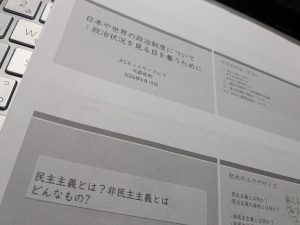
今回のテーマは「日本や世界の政治体制について:政治状況を見る目を養うために」。講師は、早稲田大学の大森佐和さんでした。
この講義の目的は、有権者である日本国籍を持つJFCたちに日本の政治体制や選挙制度について理解してもらうこと、そして、一人の有権者として、選挙の際に1票を投じてもらうことです。そして、勉強会に参加した彼女たちが、日本の政治体制や選挙制度について理解し、日本語ネイティブではないが、日本在住のフィリピンルーツのJFCたちにそれを理解してもらうために、資料や動画を作成する予定です。
講義の内容は、
1)民主主義とは何か?
・民主主義体制とは
・非民主主義体制とは
2)議員内閣制と大統領制の比較
3)連立政権の類型について
4)日本の選挙制度について
でした。講義の初めのエクササイズとして、「民主主義とは何か?」「民主主義の条件とは何か?」「非民主主義とは何か?」「非民主主義の条件とは何か?」について、生徒一人ひとりから3つ思い浮かぶ言葉を書いてもらいました。
「民主主義」についてどの生徒からも出なかったのが「選挙」、一方、「非民主主義」についてどの生徒からも出たのが「独裁」でした。
一言で「民主主義」といっても国によって民主主義度はいろいろで、民主主義をどう測るか?の指標の説明は民主主義とは何か、を考えるのに良い勉強となりました。
大統領制のフィリピンと議院内閣制の日本。この両制度の長所と短所の説明を受け、どちらがいいのか…と考えた時、フィリピン生まれでフィリピン育ちのJFCたちは、フィリピンの歴史から、大統領制は独裁体制を生み出しやすいのではないか…と考えたはずです。大統領制は国民が直接国のリーダーを選ぶことができるが、議院内閣制ではそれができません。しかし、大統領は憲法で定められた決まった任期があり、任期中は不信任だからといって解任されません。一方、議院内閣制は議会による内閣不信任決議案で総理大臣が辞めることが可能です。
権力分立という点から観ると、大統領制は執政府と立法府が独立し、互いに依存していないが、議院内閣制では執政府と立法府は相互に依存していて、権力は分離していないどころかむしろ融合しています。いろいろな観点からみるといずれも長所・短所があり、いずれが優れたものなのかを考えるにあたり、「うーん」とうなってしまいます。
最後に講義を頂いた「日本の選挙制度」についても、生徒たちはこんなに具体的に説明を受けたのは初めての事だったに違いありません。「比例代表制度」と「小選挙区制度」の長所と短所の説明がありました。「小選挙区制度」は死票が多く、社会の多様な利害が反映されにくくなり、わずかな得票差が課題に議席差に反映するので、安定した政権が生まれやすいという説明を受けた時、恐らく生徒たちは今の日本の長期政権の理由に納得がいったと思います。
10時~14時半まで、たくさんの大切なテーマについての講義を受けました。講義後、生徒たちは午後6時まで、今後の資料作りと動画作りや役割分担についての話し合いをしました。
本当に有意義で充実しきった時間を過ごしました。大森さんがおっしゃっていた「権力の批判は自分の権利を守るため」というのを心に留め、日本の民主主義スコアをこれ以上下げないよう、みんなで賢くなっていきたいと思います。
On April 19, 2026 (Sunday), we held a JFC Youth Study Session♪
The theme of this session was “Political Systems in Japan and Around the World: Developing a Critical Eye for Political Situations.” The lecturer was Ms. Sawa Omori from Waseda University.
The purpose of this lecture was to help JFCs with Japanese nationality, who are eligible voters, understand Japan’s political system and electoral system, and to encourage them to exercise their right to vote as individual voters.
Furthermore, the participants plan to create materials and videos to help JFCs of Filipino roots residing in Japan—who are not native Japanese speakers—understand Japan’s political system and election system.
The lecture covered the following topics:
1) What is Democracy?
・What is a democratic system?
・What is a non-democratic system?
2) Comparison of the Parliamentary System and the Presidential System
3) Types of Coalition Governments
4) Japan’s electoral system
As an opening exercise for the lecture, students were asked to write down three words that came to mind regarding each of the following: “What is democracy?”, “What are the conditions for democracy?”, “What is non-democracy?”, and “What are the conditions for non-democracy?”
Not a single student mentioned “elections” when thinking about “democracy,” whereas “dictatorship” was the word that came up from every student when thinking about “non-democracy.”
Even though we use the single word “democracy,” the level of democracy varies from country to country. Explaining the indicators used to measure democracy provided valuable learning for considering what democracy actually is.
The Philippines has a presidential system, while Japan has a parliamentary system. After hearing explanations of the advantages and disadvantages of both systems and considering which is better, the JFC students—born and raised in the Philippines—likely thought that, based on Philippine history, the presidential system might be prone to creating a dictatorial regime. Under a presidential system, the people can directly elect the nation’s leader, whereas this is not possible under a parliamentary system.
However, a president has a fixed term established by the constitution and cannot be removed from the position during the term due to a vote of no confidence. In a parliamentary system, on the other hand, the Prime Minister can be forced to resign through a motion of no confidence passed by the legislature.
From the perspective of the separation of powers, in a presidential system, the executive and legislative bodies are independent and do not depend on one another, whereas in a parliamentary system, the executive and legislative bodies are interdependent; far from being separated, their powers are actually combined. When viewed from various viewpoints, both have their advantages and disadvantages, and when considering which is superior, one can’t help but think, “Hmm…”
Lastly, regarding the lecture on “Japan’s Electoral System,” it must have been the first time the students had received such a detailed explanation. We learned about the advantages and disadvantages of the “proportional representation system” and the “single-member district system.” When we were told that the “single-member district system” results in many wasted votes, makes it difficult to reflect society’s diverse interests, and tends to produce stable governments because even a small difference in votes translates into a significant difference in seats, I think the students probably understood why Japan has had such long-lasting governments.
From 10:00 a.m. to 2:30 p.m., we listened to lectures on many important topics. After the lectures, the students spent time until 6:00 p.m. discussing how to prepare materials and create videos, as well as sharing tasks.
We truly spent a meaningful and fulfilling time together. Keeping in mind what Ms. Omori told us—that “criticizing power is a way to protect one’s own rights”—we want to become knowledgeable together so that we don’t let Japan’s democracy score drop any further.